↳ Refrigerator Repair
Fresh food side warm, freezer still frozen: reading a Sub-Zero built-in
On a dual-evaporator Sub-Zero, a warm fresh food compartment with a solid freezer is an airflow or defrost fault on one circuit, not a dead compressor. What to check, in order, before anyone quotes you a sealed system. Sub-Zero Repair Experts Los Angeles, (310) 496-3358.
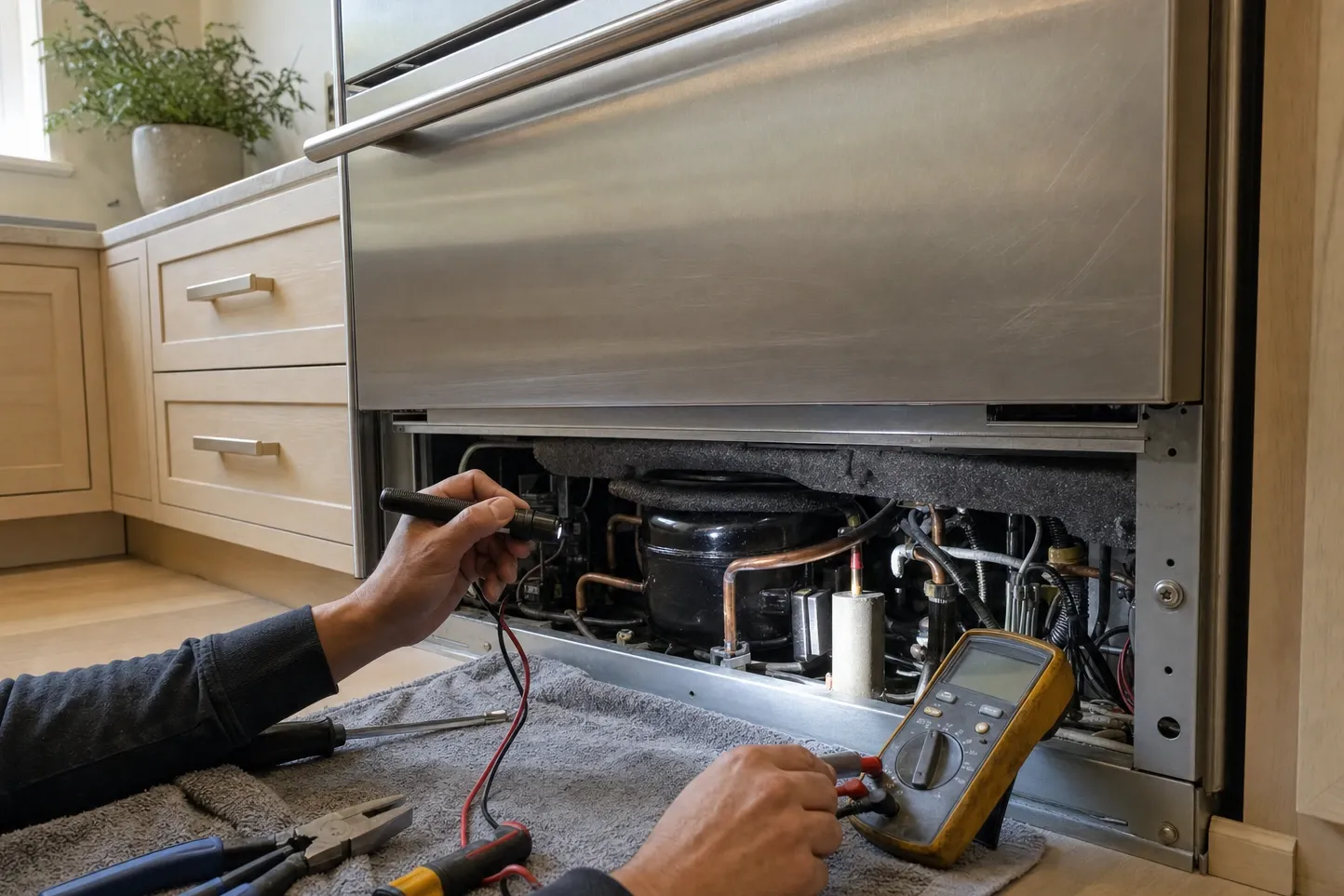
The call comes in the same way most weeks. The freezer drawer is rock solid, ice cream is fine, and the fresh food compartment two feet above it is sitting in the high fifties with the milk going off. Someone has already been told on the phone that it is the compressor and that a built-in of this age is not worth repairing.
On a Sub-Zero built-in that story is almost always wrong, and the reason is architecture. These cabinets carry two evaporators, one for each compartment, fed by one compressor and one refrigerant charge. That split is the whole diagnosis. If the shared parts had failed, both compartments would be climbing together. One compartment warm while the other stays cold means the fault is on the equipment that only serves the warm side: its air, its fan, its sensor or its defrost.
What the split actually means
Think of it as two cold rooms sharing one plant. The plant is the compressor, the condenser out front behind the lower grille, and the refrigerant that runs between them. Each room then has its own evaporator coil, its own fan pushing air across that coil, and its own thermistor telling the control board how cold the room is.
A warm fresh food compartment with a frozen freezer therefore has a short list of causes:
| What failed | What you notice |
|---|---|
| Fresh food evaporator fan | No air movement from the vents, compartment slowly drifts up |
| Fresh food thermistor | Compartment either far too warm or oddly cold, readings inconsistent |
| Defrost on that circuit | Coil behind the rear panel iced solid, air blocked by the ice |
| Blocked return air | Boxes pushed against the rear vents, or a drawer packed to the roof |
| Door not sealing | Warm room air leaking in continuously along one edge |
Nothing on that list is a sealed-system repair, and nothing on it requires a new refrigerator.
Five things worth checking before you call anyone
None of this needs tools beyond a torch and your hand.
- Put your hand at the vents. With the door open the fan usually stops, so listen at the closed door instead: a working fresh food fan is audible in a quiet kitchen. Silence on the warm side while the freezer side hums is the strongest clue you can get for free.
- Look for ice at the back of the compartment. A rear panel that is cold and beaded, or visibly frosted at the edges, says the coil behind it is icing and the defrost cycle is not clearing it.
- Pull everything off the back wall. A tray shoved against the return vents starves the coil of air and produces exactly this symptom. It is the one cause you can fix in ten seconds.
- Check the door. Close it on a dollar bill at three points along the seal. If it pulls out without friction, the gasket is soft or the door has dropped, and warm air is being invited in all day.
- Look at the condenser. Grille off, torch on. If the coil looks like a grey felt blanket, clean it. It will not be the whole cause of a one-sided failure, but a choked condenser makes every other fault worse and shortens what is left of the compressor.
Why the heat here makes it worse
Los Angeles adds two local aggravations. The first is simple: on a 98-degree afternoon in Studio City the condenser is trying to reject heat into a kitchen that is already warm, so the plant runs longer, the defrost cycle gets less recovery time, and a marginal fan or a partly iced coil that coped in March gives up in July.
The second is dust. Hillside houses off Griffith Park and up above the reservoir pull fine grit through the kitchen all summer, and it collects in condenser fins and around fan motors. We routinely find units where the actual repair was a clean, a fan motor and a gasket — and where the previous verdict, given over the phone, had been a replacement cabinet.
Older Silver Lake and Los Feliz kitchens add a third problem that is not the refrigerator’s fault at all: a column wedged into a 1920s opening with almost no clearance has nowhere to dump heat. If a unit was installed tight, it will always run hotter than the manual assumes.
What we actually do on the visit
In order, because order is what keeps a repair from becoming a replacement:
- Log both compartments against a calibrated probe rather than trusting the display.
- Meter the fresh food evaporator fan and its thermistor, then the defrost heater and terminator on that circuit.
- Pull the rear panel if there is any frost, and defrost the coil properly rather than chipping at it.
- Clean the condenser and check the condenser fan while the grille is off, whatever the fault turns out to be.
- Only then, if both compartments are wrong, put gauges on the sealed system.
The $89 service call covers that whole sequence and comes off the bill if you approve the repair. What you get at the end of it is the fault, the part and the total, before anything else is opened up.
When it is worth calling
Call when the compartment is still above the mid forties after a full cycle, when you can hear no air movement on the warm side, or when you have found ice at the back panel. Those three are not going to resolve themselves, and food in the high fifties has a clock on it.
Do not bother calling if the fix was a box against the vents or a condenser that needed a brush — that is a good outcome and we would rather you kept the money. What is genuinely not worth doing is accepting a sealed-system verdict on a unit whose other compartment is still perfectly cold. Ask whoever gave it what the readings were on the warm circuit. If the answer is vague, get a second opinion before you buy a refrigerator.
Where this goes next
When it is the frozen half that has gone instead, the page to start from isa freezer that is not freezing.
A freezer that is hard at the floor and soft at eye level is doing something else again —cold at the bottom, warm at the top sets out why.
Either way the visit is the same shape:the $89 diagnosis buys readings on both circuits, not a guess about one.
Follow-ups
Is the freezer still usable while the fresh-food half is warm?
Normally yes. The frozen side runs off its own evaporator and its own fan, so it carries on holding temperature while the other compartment is out. Shift anything perishable across, and resist filling the freezer to the liner — starving its return air turns one fault into two.
How long is it worth waiting before calling it broken?
One complete defrost cycle, which is hours on this equipment rather than days. If the fresh-food compartment is still in the mid forties once that cycle has been and gone, something on that circuit has failed outright and no amount of further waiting will bring it back.
Does one warm compartment mean the refrigerant has gone?
Very rarely, and effectively never while the freezer is still hard. Both evaporators draw on one charge, so a genuine refrigerant fault lifts the two compartments together. One warm and one cold is an air, fan, sensor or defrost problem confined to a single side.