↳ Freezer Repair
How a Sub-Zero Defrost Cycle Works, Part by Part
A freezer clears its own coil on a cycle: an element melts the frost, a sensing part ends the run, a trough carries the water out. Where that cycle breaks decides the repair — Sub-Zero Repair Experts Los Angeles, (310) 496-3358.
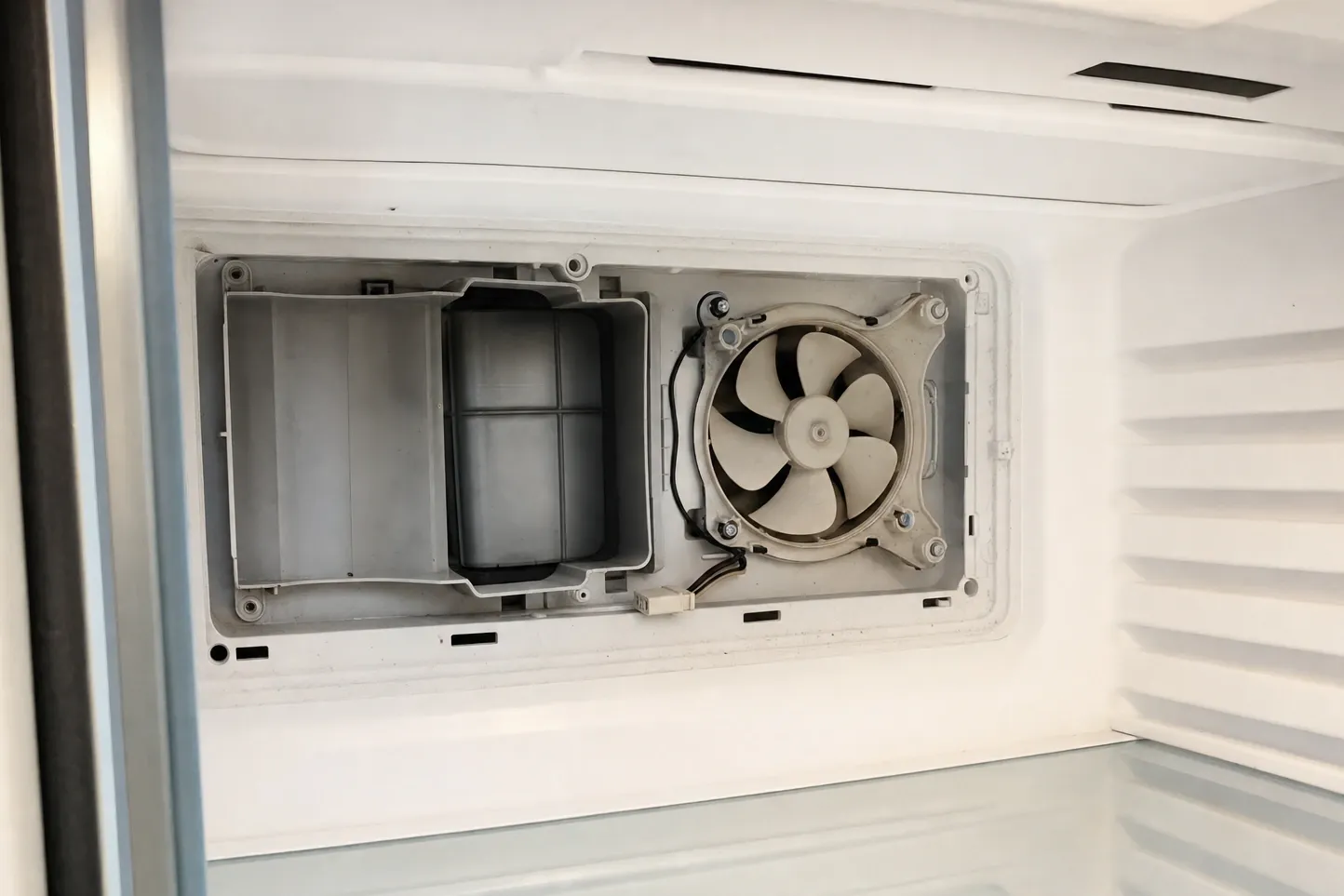
Frost inside a freezer is not a fault on its own. Each time a door or a drawer is opened, room air carries moisture in with it, and that moisture freezes onto the coldest metal available — the evaporator behind the rear panel. A cabinet with no way of shedding it would pack its own coil solid inside a couple of months. So the answer is built into the machine: a short, deliberate warming of the coil, started by the control, that turns the frost back into water and sends the water out of the box.
Almost every freezer complaint that comes in from Silver Lake, Studio City and Sherman Oaks traces back to one part of that sequence going quiet. The compartment does not stop holding temperature on the day the element dies. It stops two or three weeks later, once the fins have closed up and the air can no longer get between them.
The parts that make a defrost happen
The evaporator. A finned coil, on a freezer usually mounted across the back of the compartment behind a removable panel. Cold is made here, which is precisely why frost collects here rather than anywhere else: it is the coldest surface in the cabinet.
The heating element. A rod or a loop fitted at the coil — clamped along it, threaded through the fins or sitting beneath them, depending on how the cabinet was built. It has one job, which is to warm the fins enough for the frost to let go and run off. It is not there to warm the compartment, and on a healthy cabinet it is energised for a small fraction of the day.
The sensing part. A temperature-sensing component at the coil — a thermistor on electronically controlled cabinets, a bimetal thermostat on older ones — that reports what the coil is actually doing. Its reading is what permits a defrost to begin and, more to the point, what tells the control the coil is clear so the run can stop.
The control. The electronics that decide when the next defrost is due and what else stands down while it happens. In most designs the compressor and the circulating fan pause for the duration, which is why a defrost does not blow warm air over the food. It is also why the compartment temperature drifts up slightly while one runs.
The trough and the drain tube. Under the coil there is a moulded trough, and from the trough a tube leaves the insulated cabinet and drips into a shallow pan down in the machine compartment, where the heat coming off the running condenser evaporates it. Nothing is plumbed to a household drain. Some cabinets warm the drain path as well, for the obvious reason that a tube full of meltwater sitting in a freezer is a tube that will freeze.
How the run ends, and why that matters
A defrost is meant to finish on a reading rather than simply run itself out. The sensing part watches the coil climb, the control sees it reach the point where the frost must be gone, and the heating stops there. The compressor picks up again, the fan restarts, and the compartment pulls back down to its set point.
That is the whole safeguard, and it works in both directions. A cycle that ends too early leaves frost on the fins, and the next cycle starts from a coil that was already part-blocked, so the ice accumulates run by run. A cycle that will not end puts heat into a compartment full of food, and the owner sees the freezer soften once a day instead of seeing ice.
How often the run comes round differs between generations and between designs, and it is not a number worth quoting at a homeowner — the useful measurement is what the cabinet does, not what the schedule says. From the kitchen, a healthy cycle shows as a brief lift on the display that corrects itself without anything being touched. An unhealthy one shows as frost that returns after every thaw, or as a rise that lasts long enough to matter to the food.
Which failure looks like which symptom
An open heating element is the classic one. The cycle runs, nothing melts, and a smooth glaze builds over the rear panel that comes back within a week or two of every manual thaw. Late on, the circulating fan begins to catch the ice it is turning next to, and a scraping noise joins the warm compartment.
A failed sensing part goes two ways depending on how it fails. Reading the coil as warmer than it is, it can stop a cycle being called at all, and the symptom is indistinguishable from a dead element until a meter is on both. Reading it as colder than it is, it can let a run carry on too long, and the compartment softens noticeably at the same point every day.
A control fault is the last thing to be blamed and the first thing people reach for. It produces the odd combinations: no cycle and no alarm, or an alarm with a coil that looks fine, or fans behaving inconsistently. The sensors are metered before the board is condemned, every time, because a board fitted to fix a drifted sensor fixes nothing and is the most expensive of these parts.
A blocked trough or tube is a defrost that works perfectly and then fails at the last step. The frost melts, the water cannot leave, and it refreezes where it stands: a slab under the bottom basket, or a stripe of ice running down the inside wall. The cycle is fine. The drain is not.
Telling those four apart takes a thawed coil and a meter on each part in turn, which is most of what the diagnostic visit is for. What it produces is one figure and a named part, rather than a sequence of guesses billed one at a time.
Where this goes next
When the cycle stops finishing its job the evidence is plain enough —a smooth sheet of frost across the back wall.
The element is the commonest single failure in the group, and what changing it runs is set out underdefrost heater replacement.
A brief daily rise, by contrast, is the cycle behaving itself —a freezer that warms up once a day is where that line gets drawn.
Follow-ups
Can I just unplug the freezer overnight to clear the coil?
You can, and a full thaw does clear it. What it does not do is repair whatever stopped the cabinet clearing its own coil, so the ice returns, usually within a week or two. Treat a manual thaw as a way of saving the food and buying time, not as a repair in itself.
How do you tell the heater from the sensor without replacing both?
With a meter, at the coil, once it has been thawed properly. The element, the sensing part and the control each read differently when they have failed, and those readings are taken before anything is unclipped. Sub-Zero Repair Experts Los Angeles settles it on the $89 visit — (310) 496-3358.
Is a freezer that warms slightly once a day broken?
Not necessarily. A short rise that recovers on its own is the defrost doing exactly what it was built to do. What is not normal is a rise that lasts, one that softens the food, or a cabinet that never comes back down to its set point afterwards.